
2016–2026: A decade of opening up economic thinking, challenging orthodoxy and putting new ideas into practice.
Ten years ago, Promoting Economic Pluralism (PEP) began with a deceptively simple question: how can we tackle the huge economic, social and environmental challenges facing the world if the people advising governments and businesses are trained to think about the economy in essentially one way? How is innovation possible if there is no thinking outside this economic box?
The 2008 financial crash had exposed serious weaknesses in mainstream economics. Yet despite the growing criticism from students, academics and practitioners, economics teaching and policymaking remained dominated by a narrow set of assumptions about markets, competition, growth and human behaviour.
Henry Leveson-Gower, the founder and CEO, had previously set up Heterodox Economics for Environment and Development in the noughties, but activity had floundered after the Crash focussed attention away from sustainable development. However he was inspired by the emerging student had inspired him to return to the fray.
PEP was established to help change this continuing dominance by seeking to bring a greater focus from the policy community. Our conviction was that economics should draw on a diversity of perspectives, recognise the complexity of real economies and encourage critical thinking rather than conformity.
A decade later, that conviction remains. But how we pursue it has evolved considerably.
2016: Bringing the economic reform movement together
Our journey began in September 2016 in the conference centre at St Paul’s Hammersmith, London, with a day workshop funded by the Cambridge Trust for New Thinking in Economics followed by an evening at the Blue Anchor pub on the River Thames. It brought together academics, economic practitioners and people from policy, finance, business, think tanks and civil society to explore how to make economic pluralism a reality.

The challenge was not a shortage of interesting new economic ideas. Ecological, institutional, feminist, behavioural, evolutionary and complexity economics were already offering different ways to understand our economies. The problem was getting these ideas taken seriously and applied.
We concluded that changing economics required engaging people outside academia, particularly those who employed economists, commissioned research and used economic advice to make decisions.
This became the foundation of PEP’s approach: connecting economic thinkers with the wider world and building demand for change.
2017–2018: Ten years after the Crash
The tenth anniversaries of the financial crisis offered an extraordinary opportunity to question whether economics had learned its lessons.
Working with the Royal Society of Arts (RSA) and a coalition of organisations, PEP organised events in 2017 and 2018 at the RSA examining the causes and consequences of the crash and the continuing failure to reform economic institutions.

The programme brought together economists, policymakers, campaigners and the public to consider not only financial reform but also inequality, environmental sustainability and political instability.
The underlying question was uncomfortable: if the economic thinking that helped create the crisis remained dominant, how could we expect fundamentally different outcomes?
These events also helped establish an international network of people committed to economic pluralism, providing foundations for our subsequent initiatives.
Changing how economics is taught
From the outset, education was central to our strategy. We wanted students to learn about different schools of economics and, crucially, how to choose and combine approaches to address real-world problems.
With support from Partners for a New Economy, we developed criteria and an accreditation scheme for Masters programmes taking a pluralist approach to economics.
Working with academics and other stakeholders, we established assessment principles and piloted a peer-review process with SOAS in 2019.
But we also learned how difficult institutional change can be. Universities were reluctant to take on additional accreditation requirements, particularly during the disruption of the pandemic.
Rather than abandon the objective, we adapted. In 2021 we developed an online directory promoting pluralist economics courses internationally, eventually listing around 70 programmes.
This experience reinforced an important lesson: changing established institutions requires more than demonstrating that an alternative is intellectually compelling.
Making new economics accessible: The Mint
One of our earliest ambitions was to create an economics magazine that would challenge established thinking while remaining accessible to people outside academia.
The result was The Mint Magazine, combining provocative journalism, interviews, analysis and fresh perspectives on economic issues, combined with monthly live events in London featuring many of the contributors to the magazine.

Over the years, The Mint has featured a remarkable diversity of contributors, from established international economists to people developing practical alternatives on the ground.
By 2021, it had published 20 quarterly issues, featuring more than 100 authors and over 50 interviews. University libraries, including Oxford, LSE, SOAS and UCL, became subscribers. Now we are approaching our 40th issue after 10 years.
The Mint continues to provide a platform for questioning conventional economic wisdom and exploring alternatives, increasingly connecting economic ideas with practical initiatives.
2019: Not the Nobel
In 2019, we took a more provocative approach.
The fiftieth anniversary of the so-called Nobel Prize in Economics offered an opportunity to question how authority and prestige are created within the economics profession.
Unlike the original Nobel Prizes, the economics prize was established by Sweden’s central bank. Its association with the Nobel name had helped give economics the appearance of an objective science, despite its deeply contested assumptions and values.
Our Not the Nobel campaign challenged this authority while celebrating economists offering fresh approaches to twenty-first-century challenges.
Instead of closed nominations and decisions by an elite committee, anyone could nominate candidates and the public could vote.
Mariana Mazzucato won the inaugural award for her work reimagining the role of the state and the creation of economic value.
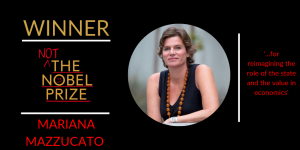
The campaign generated more than 1.3 million Twitter impressions and brought PEP to a substantially wider audience. It also demonstrated the potential of creative campaigns to make economics more democratic and engaging. Clearly it was taken seriously as 2 years latter I received a letter from lawyers representing the Nobel Foundation demanding that we cease holding this prize.
2020–2021: Festivals for Change
Then the pandemic changed everything.
Our established programme of face-to-face events stopped, while universities and many collaborators faced unprecedented disruption.
Rather than simply transfer our events online, we created something different: Festival for Change, an international digital programme supporting young people to develop ideas for a more sustainable and equitable future.

The first festival in 2020 offered workshops, discussions, mentoring and opportunities for young changemakers to collaborate across borders.
Working with more than 40 partners, we delivered 95 events and received 53 proposals from teams seeking to address social, economic and environmental challenges.
The 2021 festival built on this experience, focusing on climate change and collaboration across different cultures and circumstances.
The festivals showed that pluralism was not simply about hearing different economic theories. It was about bringing different people together, encouraging them to think systemically and helping them develop the capacity to act.
2022–2026: From economic ideas to economic institutions
As the pandemic receded, another question increasingly occupied us: how could new economic thinking be applied to actually changing the way our economies operate? Would that be the best way to getting acceptance if we could show that thinking outside the economic box provide practical solutions. Time for applying new economic knowledge….
Our work began shifting towards institutional innovation, particularly the governance and financing arrangements needed to regenerate landscapes and transform food systems.
From 2022, we explored cooperative approaches to landscape recovery, working with environmental organisations, land managers and others to understand how the beneficiaries of healthier ecosystems could collaborate in their long-term restoration.
Alongside this, we developed ideas for strengthening local food economies through shared governance, complementary currencies, cooperative infrastructure and new approaches to investment.
This direction has matured into our current emphasis on place-based economic resilience: creating practical arrangements that enable people and organisations to collaborate, share risks and sustain environmental and social benefits.
It is a different approach from the campaigns and educational initiatives of our early years, but it follows directly from their lessons.
The next decade: Putting pluralism to work
Looking back, PEP’s first decade has been a journey of experimentation, adaptation and learning.
We have challenged established economics, developed educational alternatives, created a magazine, convened international debates, celebrated innovative thinkers and supported young changemakers.
Not everything worked as originally envisaged. Some initiatives proved harder to sustain or scale than anticipated. But each contributed to our understanding of the barriers to economic change.
Perhaps our most important learning is that new economic thinking cannot transform society without new economic institutions.
As we enter our second decade, we are planning to set a new vision for the next decade working with members and stakeholders to ensure our journey continues and becomes more and more effective.
If you are interested in being part of that, contact us here.