
Nature based measures can reduce water pressures while restoring habitats, storing carbon and improving places, but their benefits in the River Almond are distributed across different sites, assets, organisations and time horizons.
This report examines how that distributed value could become credible demand for regeneration actions, drawing on catchment mapping, interviews, technical discussions, a cross-sector workshop and comparisons with established forms of collaboration.
The work identified three situations with different physical and institutional requirements: upper catchment peat and land management, urban drainage around Livingston and the protection of rail infrastructure at Winchburgh from flood risk.
Approaches based on developing nature markets with a single tradable water unit attached to interventions, as promoted for carbon and biodiversity credits, will not be effective as location and system relationships are crucial to outcomes. Site conditions, drainage connections and river systems determine who benefits from interventions, while rainfall, network operations and other land use changes make distant outcomes difficult to attribute to one intervention. Funders will be looking for interventions that are likely to deliver beneficial outcomes to them, not water units detached from water systems.
Potential funders also have different duties, interests, approval processes and budgets, while land managers require viable, long-term terms for delivery and maintenance, which can reasonably adapt to circumstances. Arrangements also need to adapt to reflect changing knowledge and policy. This process is not about one-shot deals but long-term collaboration to delivery outcomes that will be required into the foreseeable future.
Place-based ‘clubs’ can align these different needs, create necessary agreements between funders and deliverers, and allow for adaptation and learning. The term ‘club’ is used to describe formal governance arrangements for managing agreements and relationships between beneficiaries, deliverers and other stakeholders with an interest in nature based solutions. Wider governance will include informal agreement and relationships, and external regulations affecting the members of any club, all of which could affect the operations of such clubs.
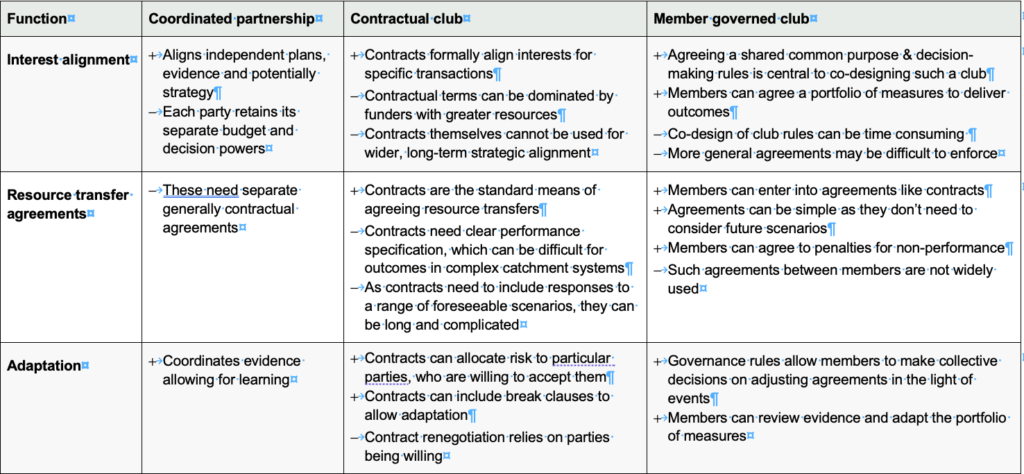
This report examines three generic types of clubs: traditional partnerships; recently developed contractual clubs and member governed clubs, which have been used in other sectors:
- Traditional partnerships can align evidence and existing programmes, but don’t have mechanisms for agreements between funders and deliverers.
- Contractual clubs can secure defined works and stewardship, but are necessarily time limited, can require levels of certainty unusual in these complex systems and lack mechanisms for broader agreements outside specific projects.
- Member governed clubs provide mechanisms where several beneficiaries and deliverers need to make repeated decisions together and adapt to changing knowledge and circumstances based on common purposes, but require significant levels of trust and investment in developing rules for collaboration.
These models are not mutually exclusive as for instance member governed clubs will likely need to enter contracts with third parties and the need for different types can evolve as objectives, evidence and relationships develop. Being generic types, they can also vary significantly in their detailed design, operation and impacts, but their functionality remains constrained by their legal frameworks. See table comparing their ability to deliver collective action requirements.
In these cases, there are plausible scenarios for how such collaboration could evolve:
- In the upper catchment, a loose partnership could coordinate separately funded carbon sequestration and/or nature credits around sites with plausible positive water impacts while developing evidence on resulting water outcomes which could then be funded through a membership governed club to allow for required future adaptation and management of a portfolio of measures.
- Livingston offers a basis for joint drainage appraisal, community participation and a portfolio of blue green measures coordinated through a partnership similar to the Edinburgh and Lothian Sustainable Drainage Partnershop while also seeking to examine evidence for flood risk reduction benefits for Edinburgh Airport and surrounding businesses. This could then underpin a similar evolution as with the upper catchment to a membership governed club, potentially even linking up to form a whole catchment membership club.
- Winchburgh probably calls for a partnership between Network Rail and developers to coordinate sustainable drainage with the potential to require upstream measures from Hopetoun Estate either through a focused project contract or wider membership club if the estate and community have continuing common interests.
There are no substantial legal barriers to creating these different types of clubs as proved by the successful precedents, however they have not become common practice. Stakeholders suggested funding and leadership were lacking, while relevant regulations and responsibilities were complex, potentially creating blame games rather than collaboration. It was also noticeable that the report faced challenges in securing stakeholder engagement, which may be down to the focus of Scottish Government, as with UK Government, policy being on private investment, nature markets and code development, rather than supporting catchment collaboration to deliver water outcomes and other benefits.
Hence the following recommendations were made to the Scottish Government:
- There is a need for specific distinct policy development on supporting catchment, landscape or placed based regeneration to deliver multiple outcomes, separate from policy development on private finance, nature markets and codes.
- This policy should develop principles for good governance of such regeneration with a learning community of practitioners and stakeholders.
- Explicit funding should be available to support building collaboration, evidence and common purpose in line with agreed principles with ensured continuation until a club is well established and can be self-funding.
- Support improved understanding of relevant regulations and responsibilities on which further collaboration can be built and blame games and funding of actions that are already required can be avoided.
See full report here.