
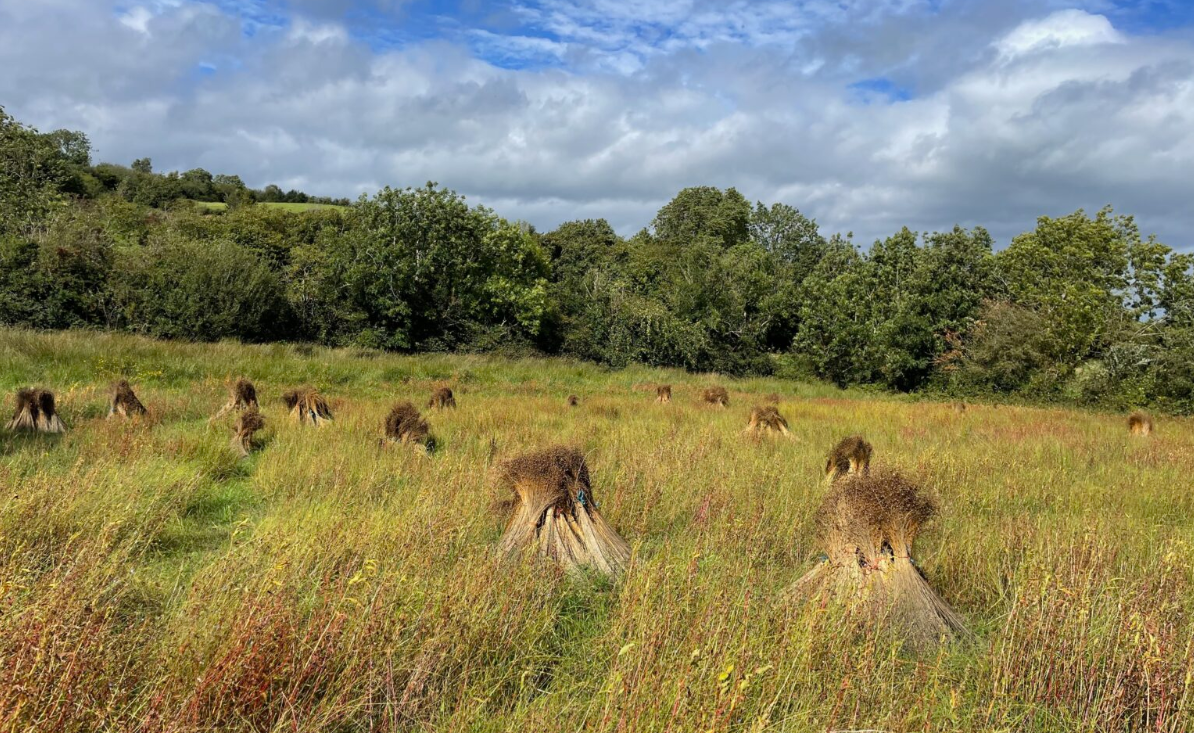
PEP is providing economic and project management support to an ADOPT-funded project in Devon exploring whether small-scale flax processing can help growers retain more value from their crops—and what it takes to build a more resilient local economy.
What connects a field of flax in Devon with economic pluralism? Quite a lot, once we start asking who has the skills, equipment and opportunities to turn that crop into a livelihood.
Flax produces the fibre used to make linen. But growing it is only part of the story. Before its fibres can be spun, the harvested stems need processing. Without access to suitable equipment and knowledge, farmers face a significant barrier to reaching higher-value textile markets.
A new project is exploring how to overcome that barrier involving organic grower, Fresh and Green Vegetables, the Apricot Centre and Liflad, experts in fibre system design. Supported through ADOPT, part of Defra’s Farming Innovation Programme delivered in partnership with Innovate UK, it will test whether growers can use small-scale processing to produce saleable long fibre.
For PEP, this offers a practical opportunity to explore how economic change happens: through collaboration, investment in skills and careful experimentation rooted in a particular place.
Can growers capture more value?
The project is led by Ruth Hancock of Fresh and Green Vegetables, an agroecological growing business in East Devon. It brings together Liflad, founded by flax and textile specialist Zoe Gilbertson, and the Apricot Centre, a commercial farm and education organisation near Dartington. PEP CEO Henry Leveson-Gower is supporting the work as ADOPT Project Facilitator and economic adviser having supported the original bid to ADOPT.
Their central question is straightforward: can farmers make flax a more viable enterprise by undertaking the first stages of processing themselves?
The trial will examine retting—the controlled process that loosens the fibres within the stems—followed by breaking and scutching, which separate the fibre from the woody material. The aim is to produce long fibre suitable for textile uses.
That requires more than demonstrating that the machinery works. The team will record labour, processing time, fibre yield and quality, equipment requirements and costs. It will also assess how readily growers can learn the skills and fit processing into an already busy farm business.
A higher selling price for processed fibre does not automatically mean a better return. The trial needs to establish how much usable fibre emerges, what it takes to produce it and whether the additional income justifies the work.
Learning from the field—and feeding it back
The project will begin with flax harvested before the trial, using it to establish what processing involves and where quality problems arise.
Those findings will inform a 2027 growing cycle. Decisions about growing, harvesting, drying and handling will be considered alongside the quality of fibre they ultimately produce.
This creates a useful feedback loop. Processing experience can help growers understand what needs to change in the field, while farm experience can reveal whether a technically successful process is practical.
For Ruth, flax is also an opportunity to investigate a further crop within a diverse vegetable-growing system. Its suitability for the rotation and any potential soil benefits need to be understood alongside its commercial prospects.
The Apricot Centre’s farming and education work will help bring growers and learners into that process. Planned outputs include practical demonstrations, a grower guide and technical guidance, so the learning can inform decisions beyond the participating farms.
Why this matters to economic pluralism
This project provides an opportunity for explore development of sustainable, resilience local food and fibre economies drawing on a range of expertise.
Farmers understand the demands of their land and businesses. Fibre specialists bring knowledge of materials and processing. Educators understand how practical skills can spread. Economic analysis helps examine costs, returns and the conditions under which adoption might make sense.
Together, these perspectives also open up questions about how production could be organised. Should each farm process its own crop? Could growers share equipment, or use a local processing service? Which arrangements would make the best use of scarce time, skills and investment?
The answers will depend on evidence and local circumstances. Public funding creates space to investigate those questions and share the learning, including the difficulties.
The ambition is to establish whether an accessible route from farm-grown flax to saleable fibre can support viable livelihoods. In doing so, the project will explore how practical knowledge, collaboration and local infrastructure can expand the choices available to growers.